 It happened so many years ago. We’re generations away from the Jews who lived during the times of the Churban Beis Hamikdash. How are we, in 2016, supposed to feel the pain of the Churban on a personal level, the way we know we should?
It’s something we all need to work on, of course, and I’m not here to offer words of mussar on the topic. But what I can do is recommend one excellent way of connecting to the Churban: read Chains, an exquisite historical novel written by talented author Leah Gebber. Set in this exact time period, during the destruction of the second Beis Hamikdash, this is a book that pulls at your heart and brings you to tears just by virtue of the vivid descriptions of the times—all meticulously researched and accurate—and breathtakingly beautiful writing style.
You’ll immediately feel connected to the characters in the book: the brave Shulamit; her stoic cousin Mariam; Chanan, whose heart lies in one big state of confusion, and the rest of the cast. Your breath will catch in your throat as you follow their suspenseful saga. More importantly, you’ll receive an inkling of how the Jews felt as they were led, in chains, by their hated captors, to Rome, the city that was the antithesis of the kedushah of Eretz Yisrael…
Reading this book will change the way you recite the Kinnos on this year’s Tishah B’Av. It will put new understanding of the pain of the Churban and of galus into your heart. Your connection with Klal Yisrael’s glorious past will be strengthened—as will your prayers of Hashiveinu Hashem eilecha v’nashuvah…
Click here to purchase online.


 Posted by anamericanjew
 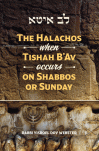 This year, Tishah B’Av is a nidcheh—it falls out on Shabbos, and is therefore pushed off until the next day, Sunday. This makes for some unusual halachos which, in a regular year, would not necessarily apply.
 I’d heard the name thrown around numerous times: Heleni Hamalkah. Between the Gemara learners in my life (read: father, brothers, husband), and whatever I managed to pick up during Jewish history class in high school (hey, not everyone sleeps during those classes; there are some of us who actually enjoy learning about our past!), her name was certainly not unfamiliar to me. Yet I never knew that this Heleni Hamalkah from the Gemara—or, in the English vernacular, Queen Helene—actually had an incredibly fascinating background and story to her.
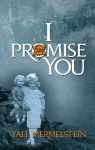 While working on
  It was a rainy Sunday afternoon, during the Three Weeks.
 There’s a woman I know who was born missing one hand. She was fitted with a prosthetic, which I’m sure she wore, while she was single, whenever she was in public, and especially while dating. But now she is baruch Hashem happily married and the mother of a lively brood, and I suppose she feels no one is judging her anymore. Add the fact that she finds the prosthetic to be bothersome and uncomfortable (she has taught herself to do everything using just one hand)—and she decided to give up wearing it.
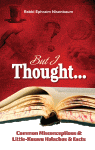 Ever heard a little kid singing a song incorrectly? He’s trying to sing “V’zakeini,” but what’s coming from his vocal chords is sounding something suspiciously like, “U’miri esa oros, ba’Torah u’manisitim…”
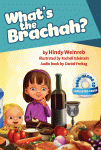 Whoever thought up the concept of children’s books accompanied by read-along CD’s must have been a genius. As every battle-weary mother knows, once your kid finds a book she absolutely loves, she will ask you to read it to her 250 times. At the very least. With a read-along CD, your vocal chords are given a rest, as you can cheerfully let your finger do the work for you—by simply pressing “Play.” What an amazing idea!
 A rabbi, a priest, and a minster walk into a bar. The bartender says, “What is this—some kind of joke?”
 Weight is one of those heavy topics (pun intended), especially when it comes to shidduchim. But
 thenextpage-israelbookshop.com