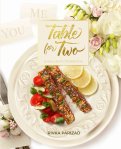
 “I just made the S’mores Bars—they came out yuuuum! And I’m so proud of myself—they look exactly like the ones in the photo!”
“I tried the Sweet Chinese Chicken for supper—everyone’s plates were licked clean!”
“I had a ton of oatmeal to use up, so I made the Apple-Cinnamon Oatmeal for breakfast. So easy, and it was really filling—and delicious!”
Just a sampling of the rave reports that came pouring into our office just days after the release of Table for Two—A Kallah’s Cookbook. (The editor and proofreader actually gave their two-thumbs-up reviews before the cookbook came in—they snuck the recipes from the PDFs they were working off…shh!)
Let me set the record straight here: although yes, this cookbook is absolutely perfect for the kallah and newlywed just starting out in the kitchen, it is definitely not limited to those starry-eyed young ‘uns among us! The recipes here can—and SHOULD!—be used by every cook who’d like to see her food being eaten and blissfully enjoyed by her loved ones (which includes herself, too, of course!)!
What makes this cookbook so unique is how beautifully basic and simple the recipes in it are. How many hundreds of cookbooks out there have recipes like “Balsamic-Infused Cornish Hens with Rosemary and Thyme Sauce” and “Seven-Layer-Double-Chocolate-Caramel Torte with Rhubarb and Custard Cream”? I’m not saying those recipes aren’t delicious, of course (er, I don’t know about the Rosemary and Thyme Sauce…)—but tell me, which typical, crazy-busy wife/mother/homemaker-plus-employee is actually going to make that?!
The recipes in Table for Two are different. Every single recipe is easy to make, with a short and straightforward list of ingredients that you’ll actually already have in your house—yet, to put it in the words of one of the above recipe testers, they are all yuuum!
And that’s why this cookbook is so perfect for beginner cooks, like young kallahs and newlyweds. Not every girl gets married knowing how to make cholent, or potato kugel, or even basic chicken and rice! (I know I certainly had a lot of learning to do in my first kitchen!) With the release of Table for Two—A Kallah’s Cookbook, which includes all these basic, good “heimishe” recipes, plus lots of other, not-so-basic-but-still-incredibly-easy recipes, these girls, too, can hold their heads high in their kitchens, confident in the knowledge that they can and, b’ezras Hashem, WILL become fabulous cooks in no time!
Buy this stunning cookbook for the kallah whose bridal shower you need to bring a gift to. Buy it for your wife, or mother, or mother-in-law…or yourself! All of you will love it—we guarantee!
Click here to purchase online.


 Posted by anamericanjew
  It was the weirdest feeling. For the first time, I really understood the phrase “to be someone’s puppet.”
 When it comes to “Torah heroes” we want our children—and ourselves—to emulate, it’s safe to assume that Rav Chaim Kanievsky shlit”a will be on everyone’s list. This is a gadol who has all of Torah right at his fingertips, a gadol who is literally a “living sefer Torah.”
 It’s the story we grew up on. At Bnos or Pirchei events, around camp bonfires, or at some lucky families’ Shabbos tables, this was the tale the dramatic storytellers would say over, each one outdoing the other with their descriptions of the evil galach and his black magic capabilities. (“’Aaabra Kadaaabra!’ he would say, and then—POOF! The person disappeared!”) If you haven’t figured it out by now, I’m referring to the amazing, legendary story of the Baal Akdamos.
 Did you ever wonder what it was like to bring bikkurim during the times of the Beis Hamikdash? We hear so much about it—the tremendous joy that permeated the entire event, the different steps to the process, the excitement and anticipation that ran high as the bikkurim-bearers joined the procession to Yerushalayim… Wouldn’t it be amazing if you, as a parent, could give over this emotion-laden account to your children so that they, too, could appreciate what the bikkurim-bringing procession was all about?
 Megillas Rus. We read it in shul every Shavuos, the yahrtzeit of Dovid Hamelech, Rus’s descendant. But who was this righteous convert named Rus? How did a former Moavite princess merit to become the wife of the Shofet Yisrael and the matriarch of the Davidic dynasty, culminating in Melech Hamashiach? Clearly, there are layers and layers of meaning behind this well-known story.
 The snowy weather may be clearing up (and not a moment too soon, right?), but when
  One of my sons has a boy named Tzion (short for Bentzion) in his class. Once I asked him, “What is Tzion’s last name?”
 “Please talk quietly in the hall—we want to make a kiddush Hashem!”


