“Mommy, guess what!” cries the little girl as she flings herself off the school bus and into her mother’s waiting arms.
“What?” her mother replies with a grin, taking in her daughter’s flushed cheeks, windblown ponytail, and still-sharply pleated, brand new uniform.
“We have the NICEST Morah, and we’re gonna learn how to read this year, and we’re gonna get a siddur, and…and…we even have HOMEWORK!!” This last word is said with all the self-importance a six-year-old can muster.
Her mother swallows a giggle (wonder how long the excitement for THAT will last?). She takes her daughter’s hand, and together they walk home from the bus stop, visions of a bright and cheery Bais Yaakov school dancing merrily in both of their heads.
Another jewel in the crown of Sarah Schenirer, the founder of Bais Yaakov.
As a parent, wouldn’t you love for your young and impressionable daughters to learn about this extraordinary woman; to understand how the Bais Yaakov schools they are lucky to attend came into being? Yes, your girls may be too young to read those big, thick biographies written about this great tzaddekes—but it would be so nice if there was something for young girls to read, too, about the incredible work of Sarah Schenirer…
Well, now there is!
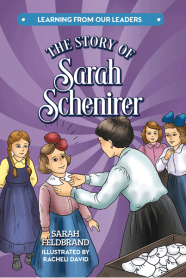
The Story of Sarah Schenirer, the second book in the Learning from our Leaders series by Rebbetzin Sarah Feldbrand, has been written specifically with beginner readers in mind. In a simple, child-friendly way, this biography for kids tells the story of who Sarah Schenirer was and why and how she began the Bais Yaakov movement. Young readers (especially girls!) will be drawn to the drama that plays out in the pages, as well as the illustrations that appear throughout the book.
Each Jewish girl attending a Bais Yaakov is another link in the exquisite chain which Sarah Schenirer began. Let your daughter understand how valuable that is! Give her the gift of appreciating her legacy.
The Story of Sarah Schenirer is an excellent place for that appreciation to start.
Click here to purchase online.
Posted by anamericanjew 
A class of bright-eyed, sweet young women graduates high school. Standing there on stage, in their matching caps and gowns, their hair carefully blow-dried, and their faces shining with their dreams for their futures (and okay, maybe some make-up, too), it’s hard to think that those futures could be anything but a bed of roses.
You know how little kids are always trying to act big? Going to sleep late like their big sibs, using adult language even if they don’t quite understand what they’re saying, dressing up in their Mommy’s high heels and Tatty’s black hat… I even have a little guy who so badly wants to be seen as a grown-up that he forces himself to eat chopped liver like the adults at the Shabbos table—even though the poor kid can’t stand chopped liver! (Don’t worry, he spits it out when he thinks no one is looking!)
One of my English teachers in high school would say that she could only give an A plus to an essay that either made her laugh or cry. I would definitely give the highest grade to
My mother has the biggest heart of anyone I know. Sending meals to neighbors who are feeling under the weather, making sheva brachos for anyone she might remotely know, visiting homebound elderly people—these are all part of her normal daily routine.
It never fails to amaze me. When a kid puts on his shoes, statistically speaking, he should have a 50% chance of putting them on the right feet, no? Of course there’s an equal chance that he’ll get it wrong, but at least half of the times he should be getting it right, right? (Ooh, that’s a good tongue twister!) So why is it that when my little ones try to dress themselves, their shoes nearly always end up on the wrong feet?
As much hype as Pesach gets, let’s face it: Sukkos can also be pretty daunting to the balabustsa. Especially this year, when we’re dealing with three sets of three-day Yamim Tovim. Coming right on the heels of all your Rosh Hashanah cooking, Sukkos requires hours and hours of standing in the kitchen, churning out recipe after recipe…unless, of course, you plan to use Julie Hauser’s cook-while-you-sleep method!
New year resolutions. That’s high on everyone’s list of priorities these days. As Yom Kippur approaches and we feverishly search for more mitzvos to do, more merits to accrue, more ways to show Hashem we’ll be better this year, we make kabbalos—pledges to grow in certain areas of our lives. For some, the kabbalah will be not to speak lashon hara for a specific two-hour slot daily; for others it may be to bentch from a bentcher; still others may choose to learn something extra each day.
“The Heavenly City… those books are incredible! You have to read them…”